



Ghana’s Minister for Education, Haruna Iddrisu, has reaffirmed the government’s commitment to embedding indigenous languages more firmly within the national education system, framing language policy as central to cultural identity, learning outcomes and future-facing innovation.
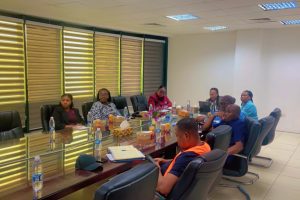
Mr. Iddrisu made the remarks during a courtesy call on the Ga Mantse, King Tackie Teiko Tsuru II, the overlord of the Ga Traditional Area, at a time when national debate is intensifying around artificial intelligence, digital inclusion and the representation of African languages in global technology platforms.
Describing the visit as his first official courtesy call since assuming office, the minister said Ghana’s education system must remain anchored in the country’s cultural foundations, even as it adapts to technological change.
“It would be unthinkable for me, as Minister for Education, to preside over a system where our education does not reflect the culture of our people,” Mr. Iddrisu said. “Language is at the centre of every culture, and under my supervision, the use of our indigenous languages in education will not be neglected.”
While reaffirming English as Ghana’s official language, the minister stressed that effective education policy requires the deliberate promotion of local languages alongside it—particularly at the foundational stages of learning. He noted that early childhood education delivered in a child’s mother tongue consistently leads to better comprehension, retention and long-term academic performance.
Mr. Iddrisu announced plans to convene a National Indigenous Languages Conference on Education before the end of March, signalling a renewed policy push to harmonise language, culture and pedagogy. He said the Ga Mantse would be invited to chair the conference, underscoring the role of traditional leadership in shaping national education priorities. Veteran journalist and social commentator Kwesi Pratt is also expected to deliver a presentation on integrating indigenous languages into formal education structures.
Citing research from Oxford University, the minister said academic studies consistently demonstrate that children learn more effectively when instruction in the early years is conducted in their first language, with second-language acquisition strengthened rather than weakened as a result.
The minister also linked language policy to Ghana’s emerging digital and artificial intelligence agenda. He disclosed that Google’s initial AI language pilots in Ghana covered only three indigenous languages. Following engagements with the company, the ministry has formally requested the inclusion of Ga-Adangme as a fourth language, with a longer-term objective of expanding coverage to all 12 approved Ghanaian indigenous languages.
“This is not only a cultural imperative but a strategic one,” Mr. Iddrisu said, describing language inclusion in AI systems as essential for ensuring that technological progress does not marginalise local identities.
He added that the initiative aligns with President John Dramani Mahama’s broader vision of promoting multilingualism across the education sector, including the expansion of sign language education to enhance inclusion for persons with disabilities.
The Ga Mantse welcomed the minister’s assurances and praised the renewed emphasis on indigenous language preservation, describing cultural identity and education as foundational pillars of national development.